Tapajós or Rio Negro: which Amazon should you choose?
The Rio Negro, reached from Manaus, is blackwater: dark tannin-stained rivers, the flooded archipelago of Anavilhanas, and the largest concentration of jungle lodges in Brazil. The Tapajós and its tributary the Arapiuns, reached from Santarém, are clearwater: transparent water over white sand, wide river beaches, and far fewer visitors. Choose Rio Negro for lodge choice and wildlife-cruise infrastructure; choose the Tapajós for beaches, swimming and community-run tourism.
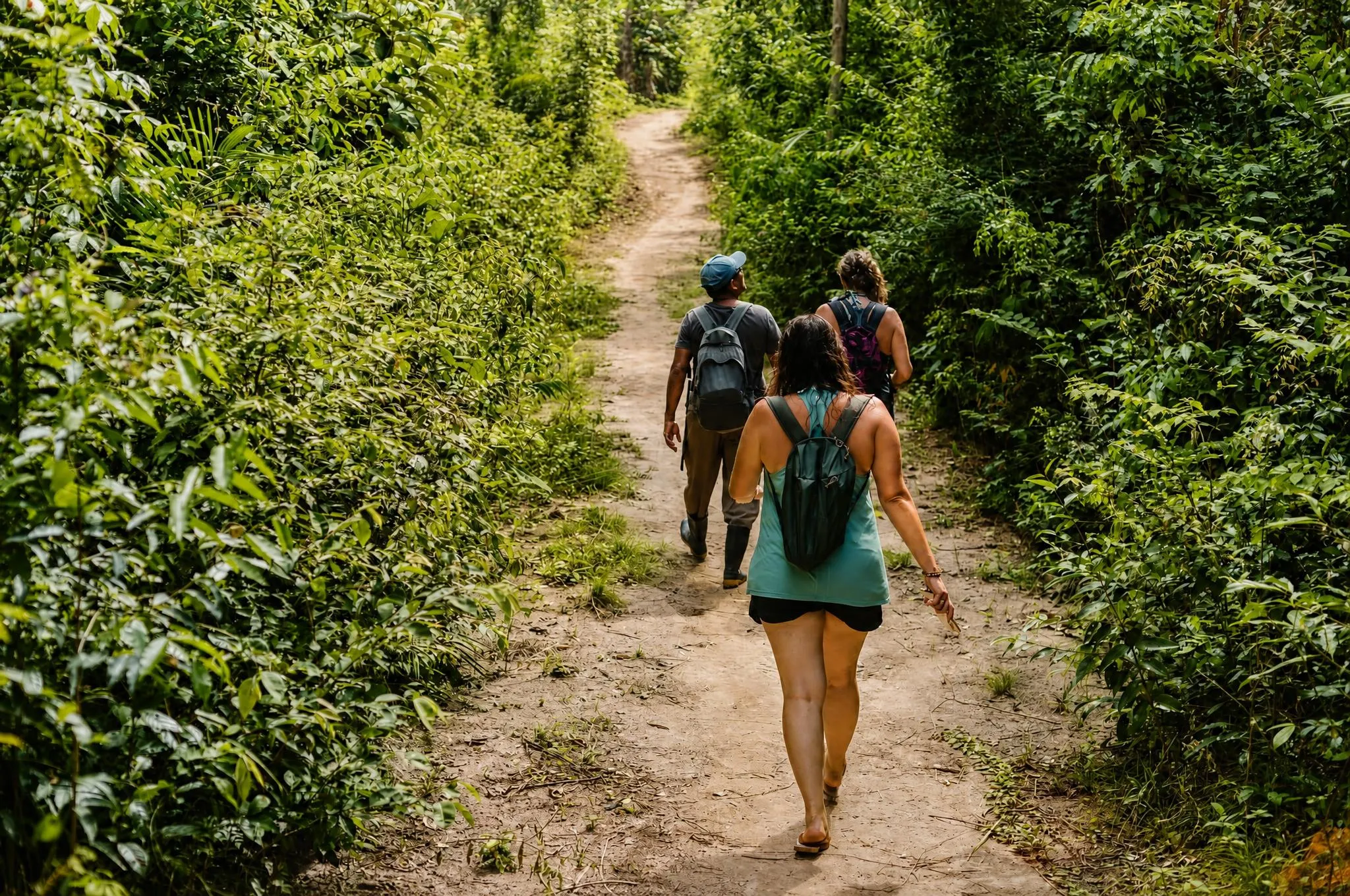
Search for an Amazon lodge in Brazil and you will get the Rio Negro. Anavilhanas, Juma, Mirante do Gavião, and — further west — Uakari in Mamirauá. Every “best Amazon lodges” list is built from roughly the same dozen properties, and almost all of them are reached from Manaus.
That is not a conspiracy, it is infrastructure: Manaus is the region’s hub, with an international airport and decades of tourism built around it. But it does mean most travellers never learn that there is a second choice, on a river that behaves completely differently. We are on that second river, so read the rest knowing where we sit.
The thing that actually differs: water type
The Amazon has three kinds of river, and they are not interchangeable.
Whitewater — the Amazon main stem, the Madeira, the Solimões. Opaque, coffee-coloured, heavy with sediment carried down from the Andes. Enormously productive, biologically rich, and not somewhere you go to see your own feet.
Blackwater — the Rio Negro. Stained dark by tannins from decomposing vegetation, acidic, nutrient-poor. It looks like strong tea. Crucially, its acidity suppresses insect life, which is why lodges there advertise low mosquito counts, and truthfully.
Clearwater — the Tapajós and the Arapiuns. Low sediment, low tannin, transparent. It runs over sand rather than mud, which is why the beaches here are white and the shallows are see-through.
Almost everything else about the two trips follows from this one fact.
What the Rio Negro gives you
Choice and maturity. A dozen serious lodges at different price points, from mid-range to genuinely luxurious, with established programmes, English-speaking guides and thousands of reviews between them. If you want to read four hundred opinions before booking, this is where you can.
Anavilhanas. One of the world’s largest river archipelagos, hundreds of islands that flood and re-emerge. Genuinely spectacular from the water.
Wildlife programming. Pink river dolphins, night caiman spotting, canopy towers. The circuits are worn in, in the good sense: people know where to take you.
Easy access. Manaus has an international airport and a big domestic network. You land and you are basically there.
Mamirauá, further out, where Uakari Lodge has been running community-based tourism since 1998 and is the benchmark everyone in this field measures against.
The honest downside: you generally cannot lie on a white-sand beach and swim in transparent water, because that is not what blackwater margins are. And you will be one of many visitors — the good lodges are busy.
What the Tapajós and Arapiuns give you
Beaches. Real ones: white sand, wide, emerging from the river as it falls between August and January. Sandbanks in the middle of the channel that you walk out onto. This is the difference people feel most immediately.
Water you can see through. Swimming as the default activity rather than an occasional dip.
Very few other visitors. Alter do Chão itself gets busy in the dry season and at New Year. The Arapiuns, an hour and a half further upriver, does not — the accommodation on the whole river amounts to community guesthouses and a small number of lodges.
Community-run tourism as the norm, not a feature. The Tapajós-Arapiuns Extractive Reserve is inhabited, and the residents hold the use rights. The farinhada, the weaving, the trails, the night fishing — these are conducted by the people who live there, and paid to them.
Lower prices at comparable quality, mostly because the region has less recognition, not less to offer.
The honest downsides. Access is harder: no direct flight from São Paulo to Santarém, then a road transfer, then a boat. Choice is thin — you are picking from a handful of places, not a market. Review volume is low, so you cannot crowd-source your confidence the way you can on the Rio Negro. And in the flood months, February to June, the beaches — the main argument for coming — are underwater.
Choosing
Pick the Rio Negro if you want a well-mapped wildlife-focused lodge trip, plenty of options at your budget, extensive reviews to read first, and simple access through Manaus.
Pick the Tapajós/Arapiuns if you want to swim in clear water off white sand, if crowds are what you are escaping, if you want the tourism to be run by the people who live there, or if you are moving a group and want a whole place to yourselves.
And a third answer nobody offers: both. There are direct flights between Manaus and Santarém, about an hour and ten minutes. A week split between blackwater and clearwater shows you more of what the Amazon actually is than a fortnight on either.
Where we come in
Villa Arapiuns is thirteen bungalows on the Arapiuns, an hour and a half by boat from Alter do Chão, inside the reserve. Full board, solar power, community-led operation, and the beach in front. Exclusive use of the whole property from fifteen guests.
If after reading this the Rio Negro is the better fit for your trip, go — it is a remarkable river and we would rather you had the holiday you wanted.
Frequently asked
Which is better for a first trip to the Amazon?
If your picture of the Amazon involves swimming and beaches, the Tapajós. If it involves boat expeditions from a well-known lodge with an established wildlife programme, the Rio Negro. Both are the real Amazon; neither is a compromise.
Is the Tapajós actually part of the Amazon?
Yes. It is one of the Amazon's major tributaries, and it joins the main river at Santarém. The forest, the reserves and the river communities are all there — it is simply a different water type from the blackwater rivers around Manaus.
Can you swim in both?
You can swim in both, and people do. The difference is that on the Tapajós and the Arapiuns you can see the bottom, and the beach is white sand rather than a dark margin.
Which has fewer mosquitoes?
Both blackwater and clearwater have far fewer than the muddy whitewater floodplain — that is why the Rio Negro lodges also advertise it. On the Tapajós the clearwater beaches are open to sun and wind, which makes them quieter still.
Is the Tapajós cheaper?
Generally yes, at comparable quality — the premium lodges around Manaus sit considerably higher per night than the Tapajós equivalents. Getting there costs the same order of effort.
Want to see it for yourself?
The conversation starts on WhatsApp: tell us your dates and group size, and we will build the rest around them.
More reading
Host your retreat on the Rio Arapiuns
A whole-property retreat venue in the Brazilian Amazon: thirteen bungalows, a covered pavilion, a yoga shala and a private freshwater beach, for groups from fifteen guests.
August 31, 2026
What community-based tourism is — and how it works in practice
Community-based tourism isn't tourism with a community visit tacked on. It's tourism where the people who live there decide, run it, and get paid. How that works inside an extractive reserve on the Rio Arapiuns.
August 30, 2026
Best time to visit Alter do Chão: a month-by-month beach calendar
When the Tapajós and Arapiuns beaches appear and disappear, month by month, and which months suit beaches, flooded forest, festivals or an empty river.
August 28, 2026