What community-based tourism is — and how it works in practice
Community-based tourism is the model where the people who live in a territory run the operation and keep the revenue, instead of being scenery or labor for an outside business. On the Rio Arapiuns, this happens inside the Tapajós-Arapiuns Extractive Reserve, where communities hold the right to use the territory: the guides, the kitchen, and the workshops belong to the people who live there, and the activities are paid directly to the families who run them.
The phrase “community-based tourism” has become a label, and labels wear out fast. So it’s worth separating what it actually means from what usually gets sold under that name.
The difference that matters
The conventional model works like this: an outside company sets up an operation in a territory, hires a few local residents for operational roles, adds a “community visit” to the itinerary, and takes the revenue back to wherever it’s headquartered.
Community-based tourism flips three things: who runs it, who gets paid, and who decides.
It’s not a question of goodwill — it’s a question of structure. You can be environmentally exemplary and socially extractive at the same time: solar power, zero waste, and the neighboring community reduced to scenery by the end of the day. The question community-based tourism asks isn’t what the trip’s footprint is. It’s whose business this is.
What the extractive reserve changes
The Arapiuns runs inside the Tapajós-Arapiuns Extractive Reserve, and that’s not a bureaucratic detail — it’s the legal foundation for everything else.
An extractive reserve is a sustainable-use conservation unit, and the decisive word is use. Unlike a national park, it was created to be inhabited: the traditional populations who already lived there have recognized rights to use the territory, under management rules they agreed on among themselves.
Two practical consequences.
The first: the community isn’t asking permission to work its own land. The right is theirs.
The second, more concrete: the Arapiuns has a formal Fishing Agreement — a collective instrument that defines who fishes what, where, and when. That’s why night spearfishing, done with a flashlight and a zagaia — a hand spear — is an activity the residents can teach: they have the right to fish there, under rules they helped write themselves. And it’s the same reason it isn’t, and can’t be sold as, sport fishing.
What this looks like day to day
No abstraction — what actually happens:
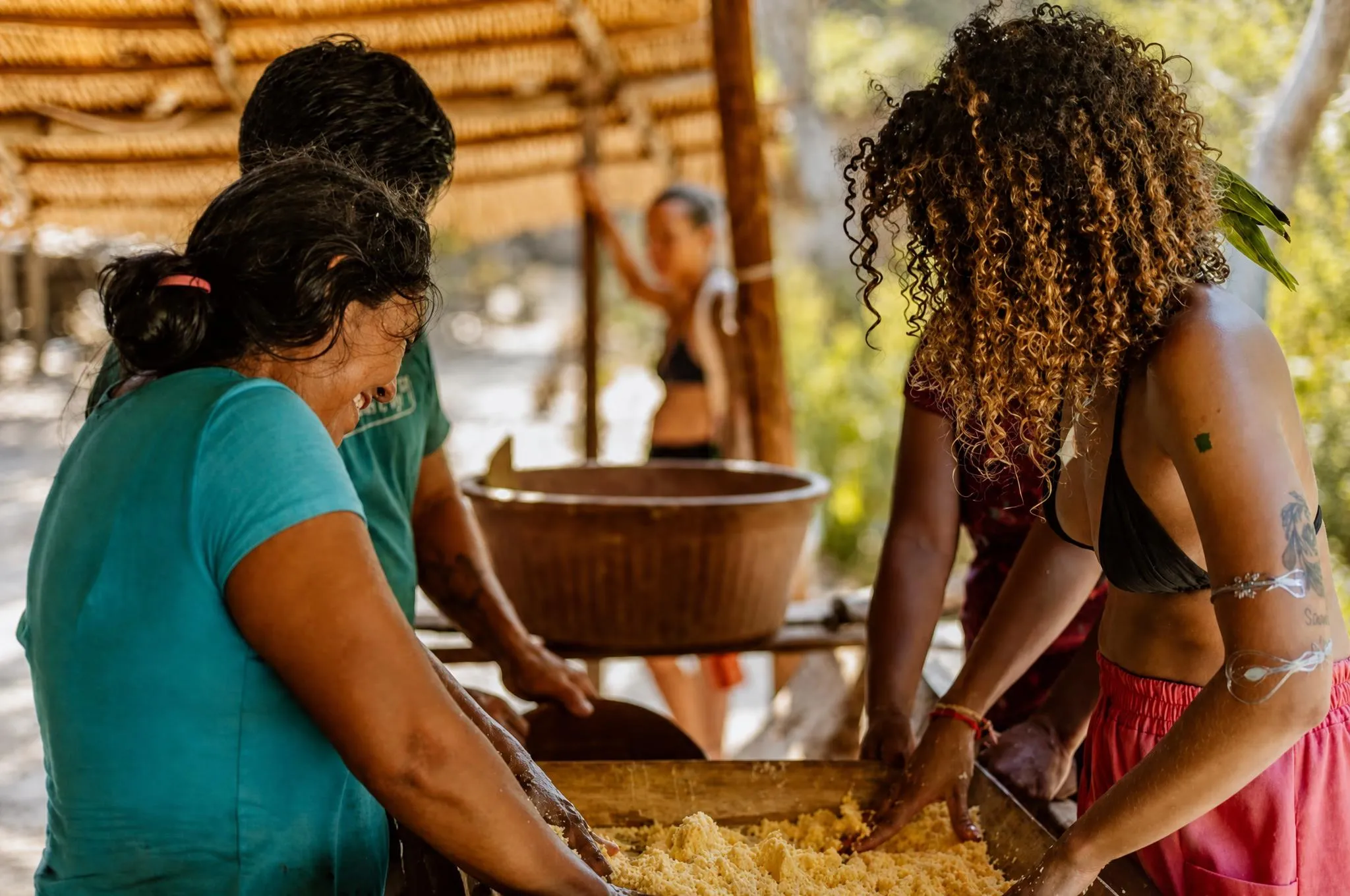
The farinhada. Cassava turned into flour, in the community oven. It’s not a demonstration staged for visitors — it’s what happens there every week, and you can join the process. Whoever teaches it is the one who does it.
The weaving. The artisans braid palm fiber and dye it with urucum. The piece comes off their hands, and the payment goes to them.
The trails. The walk to the samaúma tree starts from the community of Atodi, with a local guide, with residents. Whoever knows the path is whoever grew up on it.
Spearfishing. At night, by flashlight, freediving, with a zagaia. Learned from the people who fish.
The kitchen. River fish, flour from the neighboring communities, coffee brewed fresh. And the piracaia: fish roasted in the sand, in banana leaf, by candlelight, served in a circle by the team that lives here.
Direct payment. The activities run by the communities are paid to the families who run them — that’s why we ask guests to bring cash. It’s inconvenient to organize, and that’s the whole point: the money doesn’t pass through us before it reaches whoever did the work.
Where we’re not ready to promise yet
If this piece stopped here, it would be marketing copy. Two honest admissions.
We haven’t published the numbers yet. How many families take part, what fraction of the team is local, how much of the activity revenue stays in the territory. The lodges that are the global reference for this model — Kapawi, in Ecuador, Posada Amazonas, in Peru — publish this as a line item, auditable. That’s the right standard, and it’s where we want to get to. Until we have a verified number, we won’t make one up.
We’re not the only answer on the river. There are community guesthouses in the Arapiuns communities, run entirely by the residents, much cheaper than the Villa. If what you want is to sleep inside the life of the river with the least intermediation possible, they’re the most coherent option there is, and saying so is more useful than pretending they don’t exist.
What the Villa is, then
Thirteen bangalôs of tapajônica architecture on the bank of the Arapiuns, for up to 26 guests, with full meals and solar power. Operations and management are run by the riverside community; the activities, by the people who live there. From 15 people, the group gets the whole Villa.
It’s community-based tourism with lodge-level comfort — and the reason we’re writing this is that those two things rarely show up together, and when they do, it’s almost always the second one that eats the first.
Frequently asked
What's the difference between community-based tourism and ecotourism?
Ecotourism is about the environmental impact of the trip. Community-based tourism is about who's in charge and who gets paid. A lodge can be environmentally spotless and still treat the neighboring community as scenery.
What is an extractive reserve?
A sustainable-use conservation unit, created to be inhabited: the traditional populations who already lived there gain recognized rights to use the territory, under management rules agreed on collectively. The Tapajós-Arapiuns RESEX is one of them.
How do you know if a place is really community-based?
Ask three things: who runs the activities, where the money from them goes, and who decides what's on offer. If all three answers point outside the territory, it's tourism in the community, not tourism of the community.
Do I need to bring cash?
Yes, for the activities run by the communities: they're paid directly to the families, and there's no card machine in the middle of a reserve. Agree on the amounts before you set out.
Does Villa Arapiuns offer ayahuasca or plant medicine work?
No. We don't offer it, we don't broker it, and it's not what we do. The Villa is a place for immersion in nature and riverside culture — when we talk about retreat, we mean well-being, silence, and reconnection.
Want to see it for yourself?
The conversation starts on WhatsApp: tell us your dates and group size, and we will build the rest around them.
More reading
Host your retreat on the Rio Arapiuns
A whole-property retreat venue in the Brazilian Amazon: thirteen bungalows, a covered pavilion, a yoga shala and a private freshwater beach, for groups from fifteen guests.
August 31, 2026
Tapajós or Rio Negro: which Amazon should you choose?
Almost every Brazilian Amazon lodge sits on the Rio Negro near Manaus. The Tapajós is the other option, and the two give you genuinely different trips. An honest comparison.
August 29, 2026
Best time to visit Alter do Chão: a month-by-month beach calendar
When the Tapajós and Arapiuns beaches appear and disappear, month by month, and which months suit beaches, flooded forest, festivals or an empty river.
August 28, 2026