Best time to visit Alter do Chão: a month-by-month beach calendar
For beaches, come between August and January, when the rivers fall and the white sandbanks emerge — October and November are the peak, with the water at its lowest and the sand at its widest. From February to June the rivers rise, the beaches go under, and the forest floods into the igapó you can paddle through. July is the turn, with the beaches coming back.
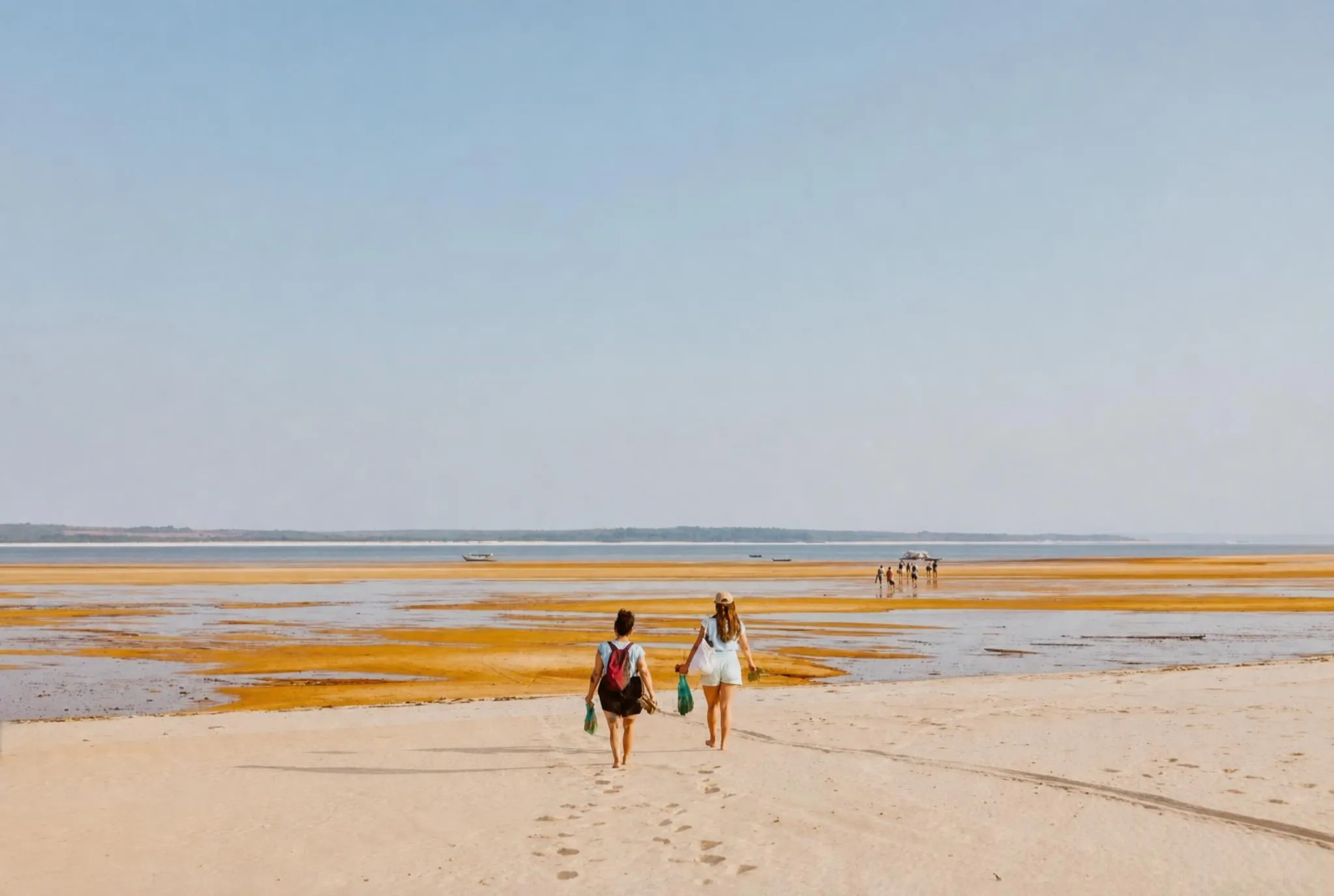
Alter do Chão has two entirely different years inside it, and which one you land in matters more than the month you choose. Most calendars for the Brazilian Amazon are written for Manaus, on the other side of the basin. This one is written from the Tapajós and the Arapiuns, where the beaches are.
The two seasons, plainly
The amazonian summer: August to January. Dry, settled sun, little rain — and, crucially, falling water. As the rivers drop, sandbanks rise out of them. This is beach season, and it is what people picture when they see photographs of this region.
The amazonian winter: February to June. Rain, and rising water. The rivers climb several metres, the beaches vanish underneath, and the forest along the margins floods. What you get instead is the igapó: paddling a canoe inside the forest, between trunks and under canopy, over ground that was walkable in October.
Neither is the good season. They are different trips, and the mistake is arriving expecting the other one.
Month by month
August. The water is falling and the first sandbanks appear. Warm, dry, and quieter than what follows. A good month if you want the beaches without the crowd.
September. Beaches established and growing. This is also Sairé — set for 17–21 September in 2026 — a festival that fills Alter do Chão entirely. Come for it deliberately or plan around it deliberately, but do not arrive unaware. Staying up the Arapiuns during Sairé is its own answer: close enough to go in, far enough to sleep.
October. Among the two best beach months. Low water, wide sand, reliable sun. Peak season.
November. The annual minimum for water level, which is the annual maximum for beach. Same weather as October, and in Brazil there are long weekends around 2 and 20 November that fill accommodation.
December. Beaches still full. School holidays start, northern-hemisphere travellers begin arriving to escape winter, and then the last week becomes New Year — Alter do Chão draws tens of thousands of people for the turn of the year, and lodging in the village goes early and expensive.
January. First half still good: beaches present, holidays running. Second half is the turn — the water starts climbing and the sand starts narrowing.
February. The beaches are going or gone. Carnival falls on 8–9 February in 2027. This is when we start describing the trip as forest rather than beach, and when people who want silence get it.
March, April, May. Full flood. No beaches at all. This is igapó season: the flooded forest at its most navigable, the light under the canopy at its strangest, and the river almost empty of visitors. It is also, for exactly that reason, when a group can have the whole place to itself — most of our retreat and private-group bookings sit in this window.
June. The water begins to fall. Beaches not back yet, but the season is turning and international traffic to the Amazon starts building.
July. Beaches returning, Brazilian school holidays, northern summer. Busy and good.
Choosing by what you want
Beaches and swimming: September to December, with October and November best.
Flooded forest and canoeing in the igapó: March to May.
Fewest other visitors: February to May.
A festival: September, for Sairé.
New Year: the window is 28 December to 2 January, and it books out first.
Wildlife: the dry season concentrates animals near remaining water, which generally makes them easier to encounter — though we will not promise you a species list, because nobody honest promises wildlife.
Two practical notes
Book earlier than feels necessary. International trips to Amazon lodges are typically planned three to nine months ahead. Retreat organisers lock a venue six to twelve months out. New Year is a single date.
Stay longer than two nights. Getting here is a full day from São Paulo and two from Europe. Three or four nights is where the arithmetic starts working, which is why our full-board rate begins at four.
What does not change
The sun is strong all year — you are near the Equator, and the pale sand and clear water reflect everything back. And the beaches have no mosquitoes in any month, which surprises people enough that it has its own page.
Frequently asked
What is the single best month for Alter do Chão?
October or November, if beaches are what you came for: the rivers are at their annual low, the sandbanks are at their largest and the weather is settled. September has the Sairé festival, which is either the reason to come or the reason not to.
Is it worth visiting in the rainy season?
For a different trip, yes. February to June has no beaches but gives you the flooded forest — canoeing between trunks and canopy where there was dry ground months earlier — plus an almost empty river. For a first visit built around beaches, no.
Is there a dry season and a wet season, or high and low water?
Both, and they roughly coincide. Locally people talk about the amazonian summer, August to January, which is dry with low water, and the amazonian winter, February to June, which is rainy with high water.
When is the Sairé festival?
In 2026 the Santarém city government has set it for 17–21 September, in Alter do Chão. It fills the village completely.
When should I book?
For the dry season and especially for New Year, months ahead — international trips to the region are typically planned three to nine months out, and the New Year window is a single fixed date against thirteen bungalows.
Want to see it for yourself?
The conversation starts on WhatsApp: tell us your dates and group size, and we will build the rest around them.
More reading
Host your retreat on the Rio Arapiuns
A whole-property retreat venue in the Brazilian Amazon: thirteen bungalows, a covered pavilion, a yoga shala and a private freshwater beach, for groups from fifteen guests.
August 31, 2026
What community-based tourism is — and how it works in practice
Community-based tourism isn't tourism with a community visit tacked on. It's tourism where the people who live there decide, run it, and get paid. How that works inside an extractive reserve on the Rio Arapiuns.
August 30, 2026
Tapajós or Rio Negro: which Amazon should you choose?
Almost every Brazilian Amazon lodge sits on the Rio Negro near Manaus. The Tapajós is the other option, and the two give you genuinely different trips. An honest comparison.
August 29, 2026