Host your retreat on the Rio Arapiuns
Villa Arapiuns takes over as a single-group venue from fifteen guests: thirteen bungalows for up to twenty-six people, a covered palm pavilion, a yoga shala, a hammock grove and a private white-sand beach on the Rio Arapiuns, an hour and a half by boat from Alter do Chão. Full board, solar power, and a local team. Rates depend on group size and nights, and the flood months from February to June are the quietest and most available.
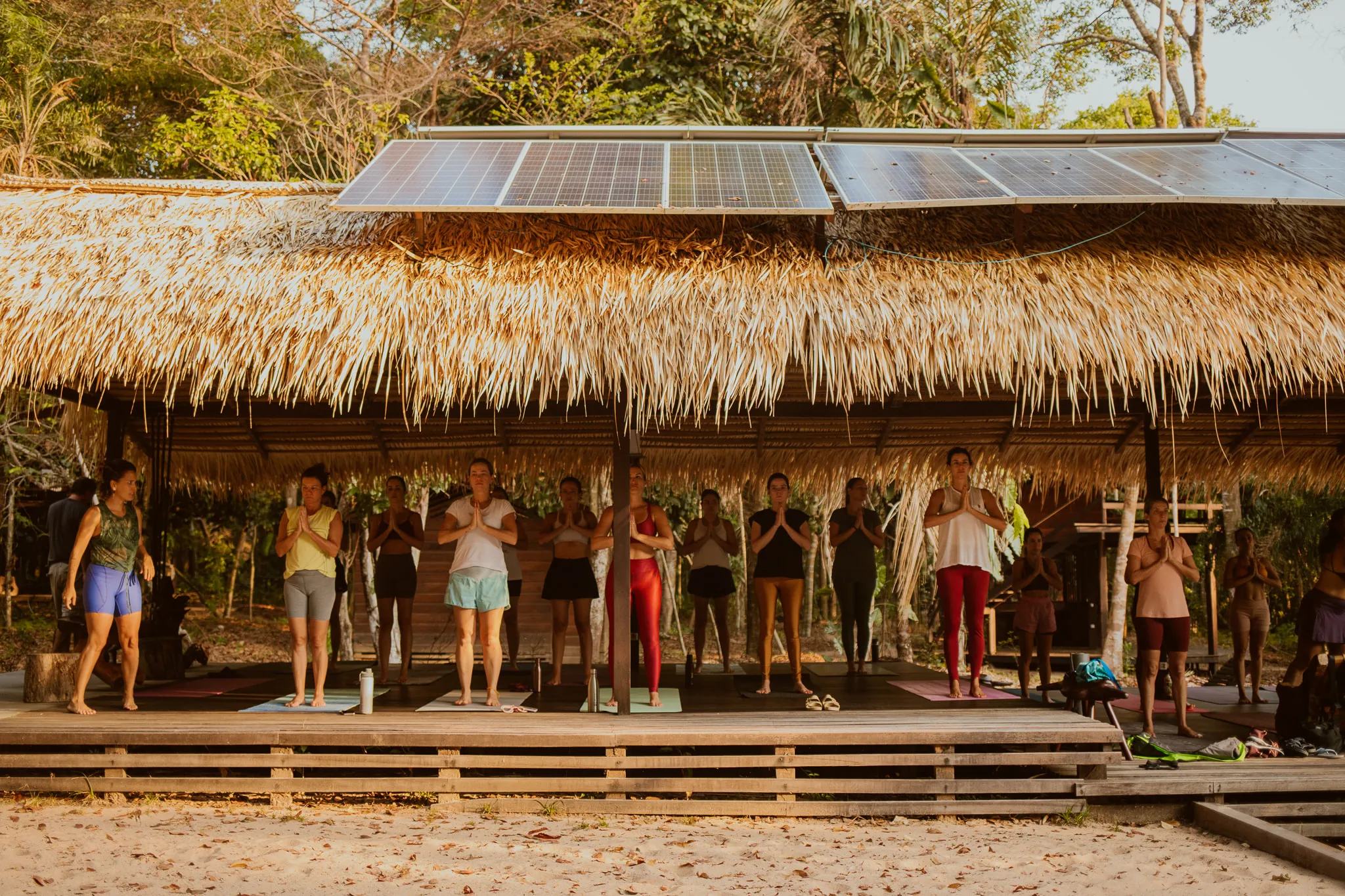
If you run retreats, you already know the hard part is not the programme. It is finding somewhere that can hold a group of twenty for a week without the venue becoming the problem — somewhere far enough to feel like a real departure, structured enough to actually function, and available as a whole so your group is not sharing breakfast with strangers.
This page is for you rather than for a holidaymaker, so it is written as plainly as we can manage, including the parts that might rule us out.
What the place is
Thirteen bungalows on the bank of the Rio Arapiuns, in Pará, Brazil — an hour and a half by boat upriver from Alter do Chão, inside the Tapajós-Arapiuns Extractive Reserve. Up to twenty-six guests. Tapajônica architecture: raised timber, palm roofing, mahogany doors with radial marquetry, hand-woven textiles.
From fifteen guests the property runs in exclusivity. For those dates, nobody outside your group is on site.
The spaces your programme needs
The pavilion. A long covered palm structure that seats the whole group together. This is the room for circles, sessions, talks and anything that needs everyone in one place and out of the sun. Solar panels sit on its roof.
The yoga shala. A dedicated deck for practice.
The hammock grove. Hammocks strung between trees — the space people go to when they need to not be in a session.
The beach. White sand, freshwater, clear water, directly in front. It is the space most groups underestimate and end up using most: dusk sessions, closings, swimming between blocks.
The dining hall. Everyone eating together, which for a retreat is a working space as much as the pavilion is.
What is included and what is not
Full board. Breakfast, lunch and dinner from the house kitchen: river fish, cassava flour from the neighbouring communities, coffee ground on the day. Vegetarian and vegan catering is routine. The house ritual is the piracaia — fish roasted on the sand in banana leaf by candlelight, served in a circle on the beach. It closes most groups’ final night without anyone having to design a closing ceremony.
The local team, who live here and run the place.
Solar power.
Activities with the communities, arranged around your schedule rather than against it: canoeing in the flooded forest, the Samaúma trail from the community of Atodi, the farinhada cassava process, palm weaving, night spearfishing taught by local fishers. These are conducted and paid directly to the families who lead them — so your group should bring cash in reais.
Not included: the boat transfer and the flights. We arrange the boat as part of a group package; the flights are yours.
The honest constraints
We would rather lose a booking than have a facilitator discover these on arrival.
Getting here is a full day. Fly to Santarém (STM) — direct from Manaus, Belém and Brasília, connecting from São Paulo — then a 40-minute road transfer, then 90 minutes by boat. From Europe or North America, count two days including an overnight in Brazil. For a five-night retreat this is fine. For a weekend it is absurd, and we will say so.
Connectivity is deliberately thin. There is Starlink, held for emergencies. It cannot support a group working online. For most retreats that is the feature; if your programme needs participants to check in with their jobs, choose somewhere else.
No beaches from February to June. The river rises and the sand goes under. What replaces it is the flooded forest and near-total quiet. It is a beautiful season and a different one — just do not sell your participants a beach in April.
We are not a plant-medicine venue. Stated again because the Amazon attracts the assumption, and because a mismatch here is bad for everyone.
No spa, no gym, no conference AV. There is a pavilion, a beach and a forest. Bring what your practice requires beyond that.
Cost, and how we quote
The rate depends on group size and number of nights, and it drops as the group grows. We quote per group rather than publishing a rack rate, because a fifteen-person weekend and a twenty-six-person week are not the same business.
For orientation on how this compares: European premium retreat venues commonly run €280–380 per person per day. We sit below that, in a location that is considerably harder to reach and considerably harder to find an equivalent for.
Tell us your dates, group size, how many nights, and what your programme actually needs from a space. You will get a real number rather than a brochure.
The window worth knowing about
February to June — the flood — is when the whole property is most available and most negotiable, and when the silence is deepest. If your retreat does not depend on beaches, this is where you get the most for your budget.
Weekdays from September to November are the best weather of the year, with wide beaches, and are the other window where a whole-property booking is realistic.
December to January is high season and New Year, and books out first.
Lead times in this business being what they are — most facilitators lock a venue six to twelve months before they open sales — the conversation for next year’s flood season is the one to have now.
Frequently asked
How many people can you take?
Thirteen bungalows, up to twenty-six guests. Exclusive use of the whole property applies from fifteen guests, meaning no one outside your group is on site for those dates. Above twenty-six, ask us.
What does it cost to host a retreat there?
The rate depends on the number of guests and the number of nights, and it falls as the group grows. We quote per group rather than publishing a rack rate — message us with your dates, group size and what your programme needs.
Is there a space for practice and for sitting in circle?
Yes: a yoga shala, and a covered palm pavilion large enough for the entire group seated together. The beach itself is the third room, and the one most groups end up using at dusk.
What is the internet like?
There is Starlink on site, kept for emergencies. It will not carry a whole group running video calls, and we would rather tell you that now than have you discover it. For a retreat this is usually the point.
Do you host ayahuasca or plant-medicine retreats?
No. We do not offer it, do not arrange it, and it is not what this place is. We host wellness, movement, meditation, leadership and creative groups. If plant medicine is central to your programme, we are the wrong venue and would rather say so before you travel.
When is the best window to book?
February to June is the flood season: no beaches, but silence, flooded forest to paddle through, and the widest availability — most of our whole-property bookings sit there. Weekdays from September to November give you the best weather of the year with the property still open.
Want to see it for yourself?
The conversation starts on WhatsApp: tell us your dates and group size, and we will build the rest around them.
More reading
What community-based tourism is — and how it works in practice
Community-based tourism isn't tourism with a community visit tacked on. It's tourism where the people who live there decide, run it, and get paid. How that works inside an extractive reserve on the Rio Arapiuns.
August 30, 2026
Tapajós or Rio Negro: which Amazon should you choose?
Almost every Brazilian Amazon lodge sits on the Rio Negro near Manaus. The Tapajós is the other option, and the two give you genuinely different trips. An honest comparison.
August 29, 2026
Best time to visit Alter do Chão: a month-by-month beach calendar
When the Tapajós and Arapiuns beaches appear and disappear, month by month, and which months suit beaches, flooded forest, festivals or an empty river.
August 28, 2026