Are there mosquitoes in Alter do Chão? The honest answer
Far fewer than you expect. The white-sand beaches of Alter do Chão and the Rio Arapiuns sit on clearwater rivers with sandy bottoms and open, wave-washed shorelines, which are poor breeding ground for mosquitoes. The insects people associate with the Amazon breed in still, shaded blackwater and in muddy floodplain — not on these beaches. You will meet them on a forest trail at dusk, not at dinner on the sand.
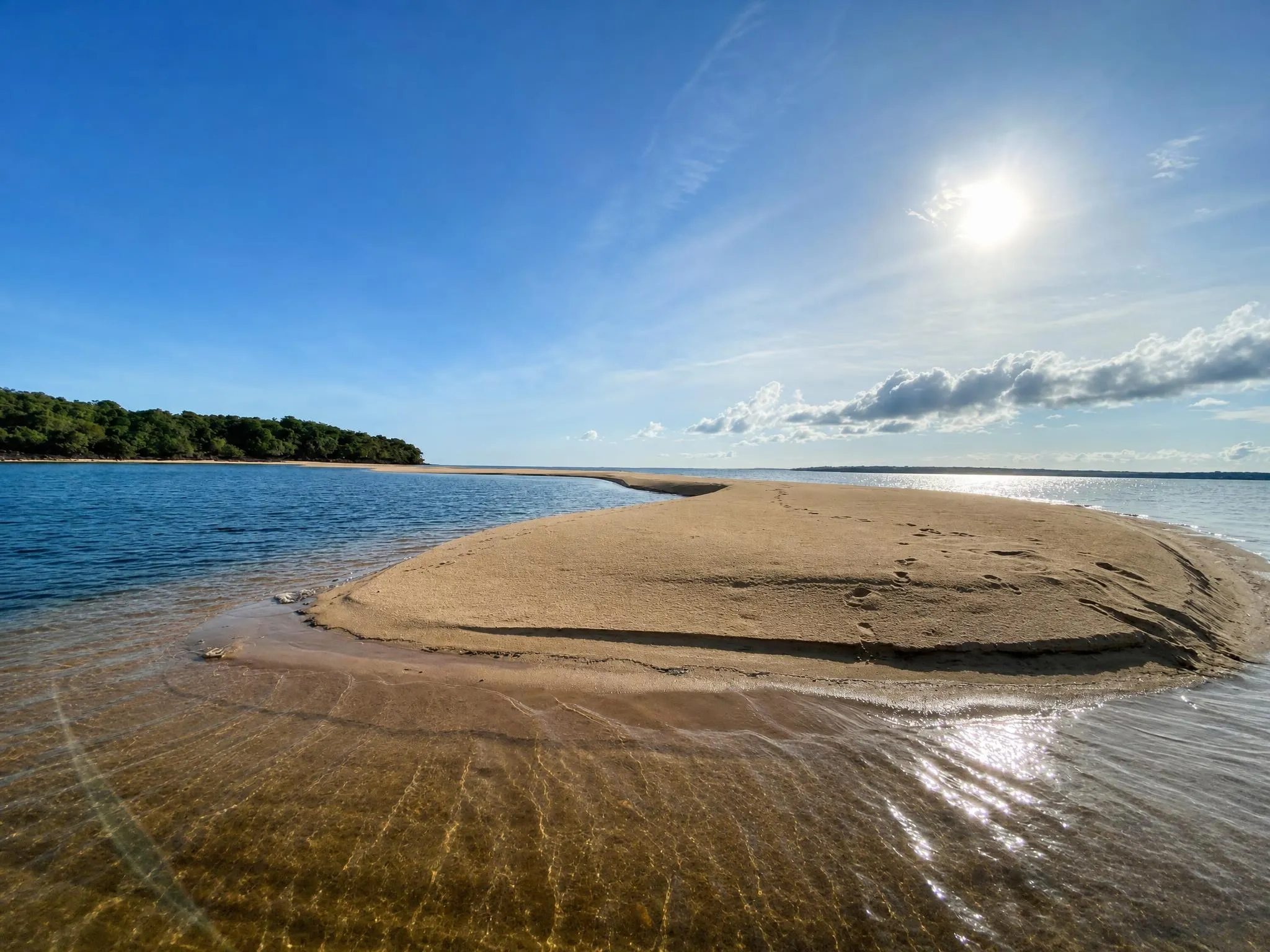
This is the question that arrives most often, usually phrased apologetically, and almost always as the last obstacle before someone books. So: a straight answer, with the reasoning, because “trust us, there are no mosquitoes” is not an answer anyone should accept.
The short version
On the beaches of Alter do Chão and the Rio Arapiuns, mosquitoes are close to absent. We serve dinner outdoors on the sand, without netting, without fogging, most nights of the year. That is not a marketing line — it is the daily operational fact that makes us willing to write this down.
On a forest trail at dusk, in the shade, you will meet insects. Use repellent there.
Why the geography does the work
Mosquitoes are not distributed evenly across the Amazon, and the difference is not luck. Larvae need still water — and preferably still water rich in decomposing organic matter.
The Amazon that produces the reputation is made of exactly that: blackwater igarapés under closed canopy, where the water barely moves and the shade is total, and várzea floodplain, where muddy sediment-heavy water sits in shallow pools for months.
The Tapajós and the Arapiuns are a third kind of river. Clearwater, running over sand, with beaches that are open to sun and wind and washed by small waves. There is no still shaded shallow for larvae to develop in, and the water is nutrient-poor — the same low sediment load that makes it transparent also makes it thin food. The result is a shoreline that is genuinely quiet.
This is worth knowing for a reason bigger than comfort: it means “the Amazon” is not one experience. Many travellers decide against the region on mosquito grounds and never learn that the clearwater basins exist.
Where the honesty belongs
We would rather be believed than impressive, so the qualifications:
This is about the beaches, not the whole forest. Walk the Samaúma trail late in the afternoon, into closed canopy, and you are in a different microhabitat. Repellent there is sensible.
Season shifts things. In the flood months, February to June, the water rises into the forest and creates the flooded igapó — beautiful, and more insect habitat than the dry-season sandbank has. The beaches themselves are underwater then, so the question changes shape.
Other places on the same rivers differ. A muddy inlet in a sheltered bay is not our beach, even a few kilometres away.
We are not making a health claim. Disease risk in the Amazon is a matter for a travel health service that knows your itinerary and your history. What we can tell you is what the evenings are like; what you need protection against is a question for a doctor.
What to actually worry about
The sun. Every time.
You are near the Equator, on pale sand, beside water that throws light straight back at you. Guests who prepared for insects and not for ultraviolet spend the third day indoors. Hat, long sleeves, high-factor sunscreen, and shade in the middle of the day.
Why we bothered writing this
Because the mosquito question is the single most common reason people talk themselves out of the Amazon, and on this particular river the fear is aimed at the wrong place. The trade-off here is real, but it is not the one you were expecting: not insects, but distance. The Arapiuns is 1h30 by boat beyond Alter do Chão, and that is the actual price of admission.
The beach is fine. Bring sunscreen.
Frequently asked
Do I need mosquito repellent in Alter do Chão?
Bring it, use it on forest walks at dusk, and expect not to need it on the beach. Most guests finish a week with the bottle nearly full.
Why are there no mosquitoes on these beaches?
Mosquito larvae need still water. A clearwater river with a sandy bottom and an open, wind-exposed shoreline gives them almost nowhere to develop, and the water carries little of the organic matter their larvae feed on.
Is malaria a risk on the Tapajós?
Risk in the Brazilian Amazon varies enormously by location and season, and the clearwater Tapajós basin is not comparable to a flooded blackwater igarapé. This is a medical question, not a travel-blog question — ask a travel health service about your specific itinerary.
What about at night, outside?
Dinner is served outdoors on the sand here, most nights, with no netting and no fogging. That is the practical test, and it is why we are willing to put this in writing.
Are there other insects to worry about?
It is a forest, so there are insects in it. Nothing that changes how you spend the day. The thing that actually hurts people here is the sun.
Want to see it for yourself?
The conversation starts on WhatsApp: tell us your dates and group size, and we will build the rest around them.
More reading
Host your retreat on the Rio Arapiuns
A whole-property retreat venue in the Brazilian Amazon: thirteen bungalows, a covered pavilion, a yoga shala and a private freshwater beach, for groups from fifteen guests.
August 31, 2026
What community-based tourism is — and how it works in practice
Community-based tourism isn't tourism with a community visit tacked on. It's tourism where the people who live there decide, run it, and get paid. How that works inside an extractive reserve on the Rio Arapiuns.
August 30, 2026
Tapajós or Rio Negro: which Amazon should you choose?
Almost every Brazilian Amazon lodge sits on the Rio Negro near Manaus. The Tapajós is the other option, and the two give you genuinely different trips. An honest comparison.
August 29, 2026